
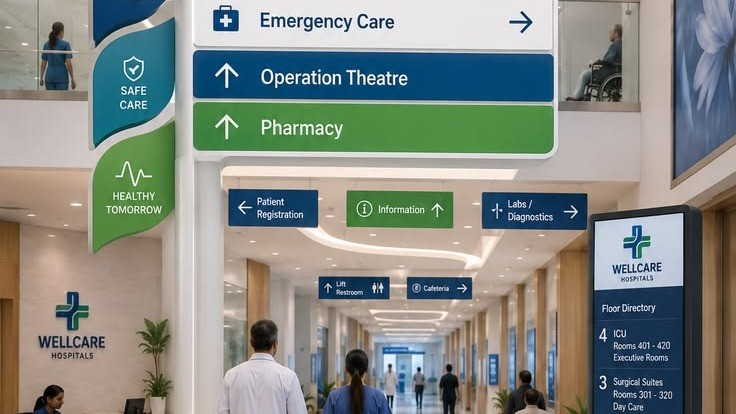
When we think about delivering excellent healthcare, we often focus on doctors, advanced medical equipment, modern infrastructure, and patient care. However, one essential element that significantly influences a patient’s experience is often underestimated—hospital signage.
From the moment a patient enters the hospital campus until they leave, every sign plays an important role in creating a safe, organized, and stress-free environment.
Professional hospital signage is much more than displaying names or directions. It is a communication system that improves navigation, supports safety, strengthens hospital branding, and enhances the overall patient experience.
The First Impression Begins Outside the Hospital
The hospital entrance is the first interaction visitors have with your facility.
A professionally designed outdoor signage system immediately communicates trust, professionalism, and confidence. Clear entrance signage, emergency department signs, parking guidance, ambulance directions, and building identification help visitors reach the right destination without confusion.
A clean, consistent, and well-maintained exterior also reflects the hospital’s commitment to quality.
Indoor Signage Creates Confidence
Hospitals can be complex environments with multiple departments, consultation rooms, laboratories, operation theatres, pharmacies, imaging centres, waiting areas, and administrative offices.
Patients and their families are often anxious. Searching for departments or asking for directions repeatedly only increases stress.
A professionally planned indoor signage system allows visitors to move through the hospital with confidence.
Effective indoor signage includes:
- Reception and welcome signs
- Floor directories
- Department identification
- OPD and IPD wayfinding
- Doctor cabin nameplates
- Room identification
- ICU and OT restricted area signage
- Pharmacy and laboratory signs
- Emergency exits
- Fire safety signage
- Washroom and accessibility signage
- Informational and safety displays
Good signage reduces confusion, saves staff time, and improves the overall hospital experience.
NABH Hospitals Need a Structured Signage System
For hospitals working towards or maintaining NABH accreditation, signage should never be treated as an afterthought.
A well-planned signage system supports a safe, organized, and patient-friendly environment while helping hospitals maintain consistency throughout the facility.
Although every hospital has unique operational requirements, a comprehensive signage strategy generally includes:
- Consistent design standards
- Easy-to-read typography
- Standardized colours and symbols
- Proper directional guidance
- Emergency and safety signage
- Department identification
- Accessibility information
- Durable materials suitable for healthcare environments
Planning signage during the design stage leads to better functionality and a more professional appearance.
Quality Materials Deliver Long-Term Value
Hospitals operate 24 hours a day, 365 days a year. Their signage must perform reliably under constant use.
Selecting premium materials offers many advantages:
- Long service life
- Easy cleaning and maintenance
- Better resistance to wear
- Excellent readability
- Premium appearance
- Consistent brand identity
- Lower maintenance and replacement costs
Quality signage is an investment that continues to deliver value for many years.
Workmanship Makes the Difference
Even the best design can lose its impact if manufacturing or installation is poor.
Precision manufacturing, accurate alignment, smooth finishing, durable fixing methods, proper lighting integration, and professional installation are essential for creating signage that reflects the standards of a modern healthcare institution.
Attention to detail is what transforms ordinary signboards into a complete hospital wayfinding system.
Experience Matters When Choosing a Signage Partner
Hospital signage requires more than fabrication skills.
A knowledgeable signage partner understands patient movement, hospital operations, healthcare environments, branding consistency, safety requirements, and long-term durability.
Before selecting a signage company, hospitals should consider:
- Experience in healthcare projects
- In-house manufacturing capabilities
- Design and planning expertise
- Quality control processes
- Material knowledge
- Installation standards
- Ability to deliver complete indoor and outdoor solutions
- Reliable after-sales service
Choosing the right partner ensures consistency, quality, and peace of mind throughout the project.
Our Commitment to Healthcare Signage
At Stonehill Advertise Pvt. Ltd., we have had the privilege of working with hospitals, medical centers, IVF clinics, dental hospitals, cancer hospitals, maternity hospitals, and healthcare institutions across Gujarat.
With complete in-house manufacturing, we deliver:
- Hospital entrance signage
- ACP façade branding
- Indoor and outdoor signboards
- Department identification systems
- Wayfinding solutions
- Doctor cabin nameplates
- Safety and emergency signage
- LED display solutions
- Reception branding
- Custom healthcare signage tailored to each facility
Our approach combines quality materials, precision workmanship, practical knowledge, and professional project execution to create signage systems that are durable, functional, and visually impressive.
Final Thoughts
Every hospital strives to provide outstanding healthcare. Professional signage plays a vital role in supporting that mission.
Well-designed signage improves patient confidence, simplifies navigation, enhances safety, strengthens the hospital’s brand, and contributes to a better healthcare experience for everyone who enters the facility.
As healthcare continues to evolve, hospitals should view signage not as a basic requirement but as an integral part of patient care and operational excellence.
Because every sign is more than a direction—it is a reflection of your hospital’s commitment to quality.